


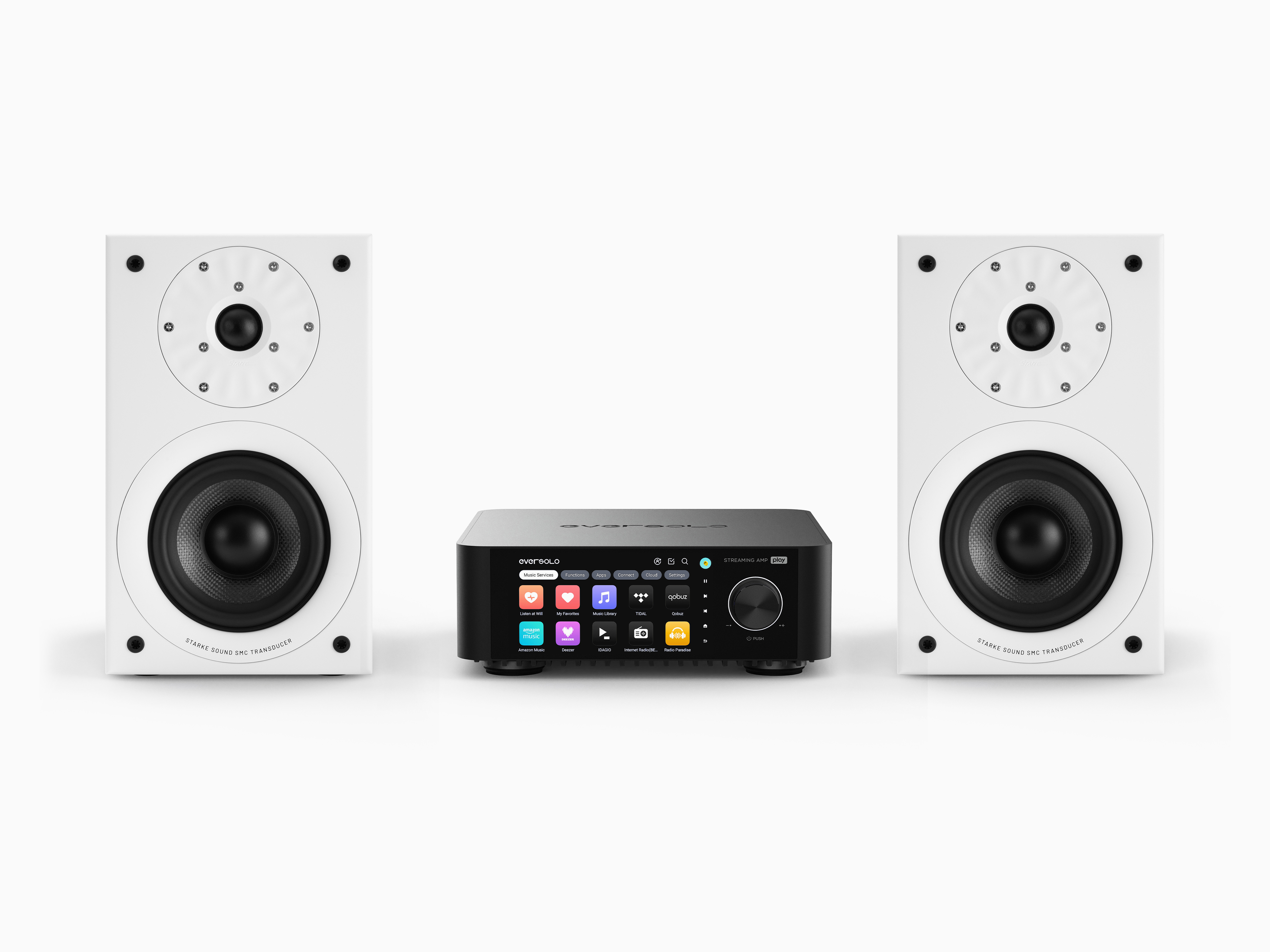
For most people shopping for bookshelf speakers under $500, the experience is the same: you’re forced to choose which flaw you can live with. Weak bass, smeared mids, harsh highs, or sound that collapses when you turn the volume up.
This was always the expectation— it’s how most speakers at this price were built. To hit a low cost, manufacturers usually cut back on the things that matter most: motor strength, cone control, and cabinet rigidity. Real high-end engineering has traditionally lived only above this price range.
The Starke Sound Beta5 was designed to challenge that assumption.
Praised by reviewers like HiFi Huff, Kpaceguy, the Beta5 isn’t just “good for the money.” It’s the result of applying high-end design thinking—careful driver selection, disciplined cabinet engineering, and extensive tuning—to components that make sense at this price, without cutting corners where it matters most.

If you care about measurable performance — frequency response, motor linearity, distortion under load — the Beta5 stands out because it doesn’t rely on tuning tricks to sound impressive. It relies on better fundamentals.
Below, we break down the actual hardware — the drivers, motor design, and cabinet construction — to explain why the Beta5 performs the way it does, and why it’s redefining what’s realistic from a sub-$500 bookshelf speaker.
What really stands out isn’t just how the Beta5 measures—it’s how it fits into everyday listening. Our listeners all talk about a soundstage that fills the room, unbelievable bass that feels full and controlled without ever calling attention to itself, and a sense of ease that makes long listening sessions effortless- all despite its compact size. The Beta5 brings music to life with a richness and scale that feels inviting, not analytical. It’s the kind of speaker that makes you linger a little longer, rediscover old favorites, and forget you’re listening to something so small—and so attainable.

What Actually Makes the Beta5 Different
Great sound doesn’t come from one magic feature. It comes from a series of thoughtful decisions—where to spend, where not to cut corners, and how everything works together once the music starts playing.
While many competitors in the sub-$500 category rely on off-the-shelf OEM drivers with standard ferrite motors, the Beta5 utilizes proprietary technology.
1. The unbelievable bass: HEMF Technology & Neodymium Motors
The most significant technical departure in the Beta5 is its motor structure. Most speakers in this price range are limited by generic, often undersized ferrite magnets that struggle to maintain linearity during dynamic peaks.
In contrast, the Beta5 features our proprietary HEMF (High-Efficiency Magnetic Field) technology. By utilizing a compound magnet system—pairing a high-grade Ferrite outer ring with a powerful Neodymium inner core—we achieve a level of magnetic flux density and control typically found only in much more expensive transducers.
- High Flux Density (B-Field): Neodymium allows for a much stronger magnetic field in a compact form factor. This results in a higher $BL$ product (force factor), giving the amplifier absolute grip over the voice coil’s movement.
- Linear Excursion: The HEMF topology ensures that the voice coil remains within a uniform magnetic field throughout its entire stroke. This is critical for reducing Intermodulation Distortion (IMD). When a woofer is trying to reproduce a deep 50Hz bass note while simultaneously singing a 500Hz vocal track, a non-linear motor will muddy the vocals. The Beta5 keeps the midrange pristine, even when the woofer is physically moving significant air.
- 108dB Max SPL: The result of this efficient motor structure is a maximum SPL output of 108 dB. This is an exceptional figure for a compact 5.25-inch driver, indicating massive dynamic headroom that avoids the "compression" often heard in lesser speakers during orchestral crescendos or action movie sequences.

2. Carbon Fiber Sandwich Cone
Cone material stiffness-to-weight ratio is the holy grail of transducer design. Paper cones can sound warm but suffer from cone breakup; aluminum is stiff but can ring like a bell at high frequencies.
The Beta5 utilizes a 5.25-inch Carbon Fiber Sandwich Driver.
- Pistonic Motion: Carbon fiber offers an incredibly high Young's Modulus (stiffness). This ensures the cone acts as a perfect piston within its passband, moving air without flexing or warping.
- Sandwich Damping: The "sandwich" construction introduces a damping layer between the carbon fiber skins. This critical engineering choice suppresses the high-frequency resonances typical of rigid materials. The result is a midrange that is transparent and uncolored, avoiding the artificial "glare" often associated with woven Kevlar or poorly damped metal cones.
3. Clarity and accurate staging: The 29mm Large Voice-Coil Tweeter
A glance at the technical specifications reveals a subtle but crucial detail: the tweeter is 1.15 inches (approx. 29mm), rather than the industry-standard 1-inch (25mm) or 0.75-inch domes.
- Thermal Capacity: A larger voice coil means a larger surface area for heat dissipation. At high volumes, voice coils heat up, increasing impedance and causing "thermal compression" (a reduction in output). The larger coil in the Beta5 maintains linearity and dynamic impact even during extended, high-volume listening sessions.
- Lower Crossover Point: The robustness of this tweeter allows us to set the crossover point at 2200 Hz. This is lower than many competitors (who often cross over at 3kHz). A lower crossover point improves the off-axis response (dispersion) and relieves the woofer from trying to reproduce upper-midrange frequencies where it might start to "beam" (narrow its dispersion). This creates the wide, holographic "sweet spot" that reviewers rave about.
Cabinet Engineering: Why Mass Matters
In the world of acoustics, mass is a virtue. The "Knuckle Test" is a favorite among audiophiles for a reason: rapping your knuckles against a cabinet should produce a dull, solid thud, not a hollow ring.
- 15 lbs (6.8 kg) Per Speaker: The Beta5 is significantly heavier than most rivals in its class. This weight comes from thick MDF walls and strategic internal bracing.
- Inert Platform: A lightweight cabinet vibrates sympathetically with the woofer, introducing "box coloration" that smears the sound.
The Beta5’s heavy, inert cabinet ensures that the mechanical energy from the driver is converted purely into acoustic energy (sound), not mechanical vibration (heat). This is why the bass response feels "fast" and "tight" rather than booming or overhang.

Technical Comparison: Beta5 vs. The Market
To visualize the engineering gap, let’s compare the Beta5 against the typical technical architecture found in standard sub-$500 bookshelf speakers.
| Feature | Typical <$500 Speaker | Starke Sound Beta5 | Audible Benefit |
|---|---|---|---|
| Magnet Structure | Ferrite (generic, slower flux recovery) | Hybrid with HEMF | Faster transient response; tighter bass; lower distortion. |
| Max SPL | 98dB - 102dB | 108 dB | Massive dynamic range suitable for both Hi-Fi and Home Theater. |
| Tweeter Size | 1 inch (25mm) | 1.15 inch (29mm) | Higher power handling; smoother highs; better dispersion. |
| Crossover Point | 2500Hz - 3000Hz | 2200 Hz | Superior midrange integration; wider soundstage. |
| Cabinet Weight | ~8-10 lbs | 15 lbs (6.8 kg) | "Blacker" background; zero cabinet resonance/coloration. |
Amplifier Matching & System Synergy
The Beta5 has a Nominal Impedance of 4 ohms and a Sensitivity of 86 dB (2.83v at 1m).
On paper, the Beta5’s specs hint at what you hear in practice: these speakers respond best to an amplifier with good current control. They’ll work happily with most modern receivers, but give them a higher-quality amp and they immediately open up—more grip in the bass, more ease at higher volumes, and a greater sense of scale.
That’s exactly why we created the Beta5 x Eversolo Play Bundle.
The Eversolo Play combines high-quality streaming with a Class D amplifier that pairs naturally with the Beta5’s impedance behavior. Together with a dedicated DSP tuning profile developed specifically for this speaker, the system takes the uncertainty out of matching components. You just connect, press play, and enjoy sound that feels balanced, controlled, and effortless from the start.
Optimizing Your Acoustic Environment
Even with reference-grade hardware, the room remains the final component in your signal chain. To achieve the "disappearing act" where the speakers vanish and only the music remains, placement is paramount.
- Positioning: Proper distance from the front wall is crucial to balance bass reinforcement with soundstage depth. For a deep dive into the geometry of sound, read our Surround Speaker Placement Guide. The principles of axis and distance discussed there apply directly to optimizing stereo imaging.
- Application: Are you building a dedicated Stereo System for critical listening, or are these the L/R channels of a Home Theater? Thanks to the high max SPL and the 45Hz extension, the Beta5 is uniquely qualified for both. They offer the delicacy required for jazz and the dynamic impact needed for cinema.
Technical FAQ
Q: Will a 4-ohm impedance damage my amplifier?
A: Most modern amplifiers, including decent AV receivers, are rated for 4-ohm loads. The Beta5 features a relatively flat impedance curve without severe phase angles, making it an "easy" 4-ohm load. As long as your amplifier is stable, it will drive them without overheating.
Q: Do I need a subwoofer given the 45Hz extension?
A: The Beta5 reaches down to 45 Hz (-3 dB), which covers the lowest note of a 4-string bass guitar and the kick drum. For most music genres in small-to-medium rooms, a subwoofer is not required. However, for pipe organ music or electronic genres with sub-bass content, or for a full theatrical experience, a subwoofer will flesh out the bottom octave (20-40Hz).
Q: Is the 45Hz extension a "real" number? How does it compare to other specs?
A: Yes, it is a strict standard. We rate the Beta5 at 45Hz with a -3dB limit, which is the industry standard for "usable bass." Many manufacturers list specs at -6dB, -10dB, or use vague terms like "Frequency Range" without any tolerance limits—essentially meaningless numbers that exaggerate performance. When we say 45Hz, we mean you will hear and feel solid, powerful bass at that frequency, not just a faint whisper.
Q: Is the break-in period real?
A: Yes, it is a physical reality of the suspension components (the spider and the surround). We recommend 20-50 hours of play time. This allows the suspension to loosen to its mechanical specification, opening up the bass and smoothing the treble response.
Q: Can these be used for Near-field Monitoring?
A: Absolutely. The low crossover point (2200 Hz) and the close physical proximity of the tweeter and woofer provide excellent phase coherence. Even at a listening distance of 1 meter (desktop use), the drivers integrate perfectly to form a cohesive point source.
For the audiophile who demands engineering excellence over brand marketing, the choice is clear. Don't just listen to music; experience the science of sound.
- Shop the Speaker: Starke Sound Beta5
- Shop the System: Beta5 x Eversolo Play Bundle
Share:
Surround Speakers: How to Place Them, Set Them Up, and Bring Your Room to Life